Anniversaries have been on my mind over the past few years. Last September, my wife and I celebrated our fifth wedding anniversary while November marked my 25th year as an IT support tech—a career that I hope to change as soon as humanly possible before it destroys my health.
Traditionally, each anniversary is symbolized by a specific, unique material. Appropriately, these materials increase in strength, resilience, or value with each passing year. For example, first anniversaries are associated with paper, fifth with wood, 25th with silver, 50th with gold, and so on.
Tenth anniversaries are marked by aluminum or tin. That being the case, you can call me the Tin Man in 2019, although I’d like to think that I have a heart.
As I reach my first decade as a published author, I am immensely grateful to the critique partners, mentors, editors, publishers, and fellow writers who helped me along the way. While writing is a solitary endeavor, publishing is a team effort.
Deepest thanks to Steven H. Wilson, Howard Weinstein, Aaron Rosenberg, Robert Greenberger, Paul Kupperberg, Nancy Sakaduski, Weldon Burge, Joanne M. Reinbold, Susanna Reilly, Stuart S. Roth, and all of my fellow members of the Greater Lehigh Valley Writers Group.
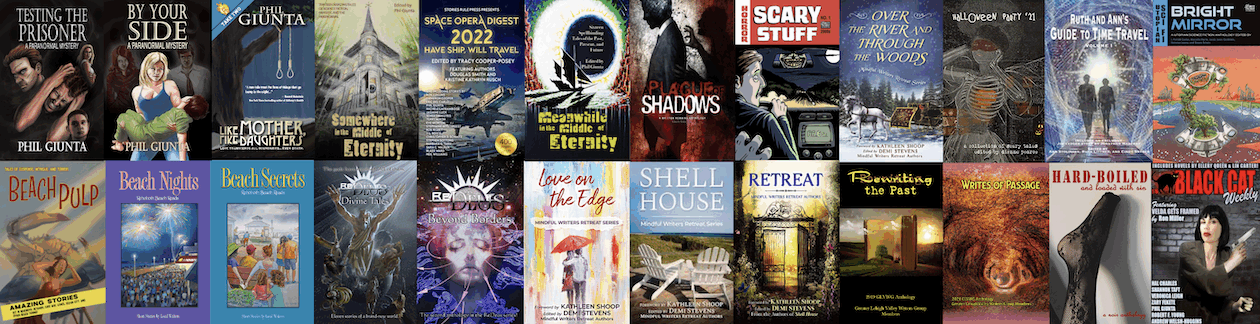
Below is an image of every book I have written or contributed to over the past ten years. I never dreamed my writing would take me this far. With three novels and nearly two dozen short stories out in the wild, I hope to continue crafting powerful fiction that changes lives and inspires readers as well as young writers.
After narrowly escaping a radiation bomb planted in his dorm room on Earth, Biron Farrill is confronted with news of his father’s arrest and possible execution by the Tyranni, alien conquerors of the Nebular Kingdoms. Farrell’s father, the famous and respected Rancher of Widemos, was believed to be involved in plotting an insurrection against the Tyranni.
According to Farrill’s enigmatic acquaintance, Sander Jonti, the arrest of Farrill’s father was arranged by Hinrik V, Director of Rhodia and obsequious servant to the Tyranni. Jonti convinces Farrill to leave Earth and travel to Rhodia to seek an audience with Hinrik. He even provides Farrill with a letter of introduction, having previously worked for the Director.
Although traveling incognito, Biron is arrested and questioned aboard ship by the Tyranni Commissioner, Simok Aratap. From the commissioner, Farrill learns that his father has been executed for treason, yet he maintains his assumed identity of Biron Malaine and feigns ignorance about the Rancher of Widemos. Aratap releases Farrill but keeps him under surveillance.
On Rhodia, Hinrik orders Farrill imprisoned and contacts Aratap. Farrill quickly escapes, aided by Hinrik’s daughter, the lovely Artemisia, and his cousin, a dilettante named Gillbret. Both despise the Tyranni and yearn to leave Rhodia. After the trio steals Aratap’s ship, Gillbret regales Biron and Artemisia with a story about a mysterious “rebellion world” where ships and men were being assembled to overthrow the Tyranni. Although Gillbret is uncertain of the planet’s exact location, there is one man who might know, the Autarch of Lingane.
Upon arrival on Lingane, Biron strikes an uneasy alliance with the Autarch and together, they embark on an expedition into the Horsehead Nebula in search of the “rebellion world.”
The Stars, Like Dust is a fine interstellar adventure that moves at a steady pace but—as with many classic SF novels—lacks much in the way of character development. Despite a few clichéd, predictable plot points and occasional melodramatic dialogue, there are one or two unexpected twists that successfully fuel story tension.
This week on the blog, we begin with the importance of downtime — in an age that constantly pushes us to the brink of burnout — and we end with the notion of writing as a release from stress.
In between, Kristen Lamb takes us spearfishing to find that perfect catch (reader) and reminds us that drudgery builds success. Dave Chesson guides us through several Goodreads features that might prove useful in promoting your book… if you don’t mind the trolls.
Over at Writer Unboxed, Jim Dempsey offers tips to help you work through problems in your story and Rheea Mukherjee provides ideas for bringing authenticity to characters with different skills and capabilities than their creators.
In the Kill Zone, Jordan Dane teaches us to tap into our waking dreams in order to enhance creativity while James Scott Bell channels Bryan Cranston. Enjoy!
During WWII, Flying Officer Alan Bishop is reassigned from England’s Northern Coastal Defence to a new project involving the development of a new radar-based airplane guidance system called Ground-Controlled Descent (GCD). Its purpose is to guide military craft to safe landings during dense fog or inclement weather. Along with a team of soldiers and scientists, and a trio of Women’s Auxiliary Air Force operators, Bishop leads the testing of the GCD in both staged exercises and actual landings in a small airfield near Land’s End in Cornwall.
Arthur C. Clarke’s only non-SF novel, Glide Path was inspired by his participation in the development of Ground Controlled Approach (GCA) during his wartime service with the Royal Air Force.
Such a topic alone does not constitute interesting fodder for fiction, and at times, I was reminded of Clarke’s Prelude to Space, a fictional chronicling of man’s first mission to the moon in the late 1950’s with little in the way of plot or conflict.
Much of the conflict in Glide Path remains in the background and stems from Bishop’s concerns over the declining health of his father, his feelings of inferiority compared to the brilliant scientists and skilled pilots on the team, pressure from skeptical generals, and an adversarial relationship with one particular RAF pilot who becomes competition for the affections of a local harlot.
Although I woke up to a gray, soggy morning, the skies cleared an hour before I began my trek to Farpoint’s 26th annual SF convention in Hunt Valley, MD.
After collecting my registration materials and checking into my room at the Hunt Valley Marriott Delta, I opened the program book directly to my second place winning story from last year’s Farpoint Writer’s Contest! Click here to read “All That Matters is What You Believe.”
In between reuniting with several friends, I scored a set of Stranger Things trading cards from friend and artist Laura Inglis, dealer room coordinator for Farpoint, Laura also created the cover art for all three of my paranormal mystery novels.
After my wife arrived later in the evening, we enjoyed dinner at the Nally Fresh in Timonium and returned to the hotel in time for the 10PM book fair. I shared a table with fellow writer pals Steven H. Wilson and Michael Critzer. Sitting in one place for two hours allows for plenty of quality time for catching up with friends in addition to selling books and happily, I did both!
Afterward, I spent some quality time at the bar with two glasses of Pepsi and fellow writers Kelli Fitzpatrick, Erik Bakutis, Heather Hutsell, Aaron Rosenberg, Russ Colchamiro, Keith DeCandido, Derek Tyler Attico, and David Mack. It was a fun end to a long day.
Saturday began with the Firebringer Press Presents panel at 11AM in Salon C hosted by Steve Wilson, Michael Critzer, and yours truly. Although our audience was small, we chatted about our current releases and upcoming projects.
At 1PM, Steve and I hosted the second stop on our book tour for Firebringer Take Two, the double horror novel consisting of Steve’s vampire tale, Freedom’s Blood and my paranormal mystery, Like Mother, Like Daughters. The launch was held in the con suite complete with lunch and dessert. Steve and I both read excerpts from our respective stories and sold several copies of the new book as well as a few backlist titles.
June Swords and I after setting up for the Firebringer Take Two book launch. Ethan and Christian Wilson in the background.
My next panel was supposed to be Fandom in Miniature, a discussion of SF toy collecting, at 3PM with Ethan Wilson, Thomas Atkinson, and Cindy Woods. Unfortunately, I found myself stuck in the endurance test known as Wallace Shawn’s autograph line. He was friendly and loquacious, engaging everyone in conversation. It was a true pleasure to meet him.
Meeting Wallace ShawnGrand Nagus Zek – Star Trek: Deep Space Nine
After sharing a wonderful dinner with Steve Wilson, June Swords, and Renfield, Evon and I decided to call it a night.
After packing up my car on Sunday morning, I dared one more pass through the Wallace Shawn autograph line. Thankfully, it was a bit shorter this time and I made it out in time to chat with writer pals Aaron Rosenberg, Russ Colchamiro, Heather Hutsell, and Michael Jan Friedman before my next event.
Vizzini – Princess Bride
At 1PM, I joined Peter David in the ballroom to co-host the screening of Dreams with Sharp Teeth, the 90-minute documentary about legendary writer Harlan Ellison, who passed away in June 2018. It was a wonderful tribute and, judging by their reactions, the audience seemed to enjoy it.
The final event of the con was Wallace Shawn’s 3PM stage talk during which he answered questions about his career as an actor and playwright. In addition to Deep Space Nine and Princess Bride, he spoke about working with Woody Allen on Radio Days and spending a year in India as a young man. Some of his responses were intentionally cryptic. For example, when it came to playing Grand Nagus Zek on DS9, Shawn said that he had channeled someone he knew personally, but would not reveal any further details. Similarly, when asked about his favorite books, he preferred to keep that a secret.
On my way out, I finally had the chance to take a brief tour of the dealer room and found a few vintage Star Trek items at incredibly low prices from a dealer who was selling off his personal collection.
Star Trek candy boxes from 1976 and Star Trek: The Motion Picture plastic cup (1979)
Of course, no SF convention would be complete without a vast array of talented cosplayers and those pictured below are only a small sampling from the weekend.
Wonder Woman (photo credit: Blair Learn)
Xena and Gabrielle (photo credit: Shore Leave)
Romulan (photo credit: Shore Leave)
Iron Man (photo credit: Shore Leave)Catwoman (photo credit: Shore Leave)Bender from Futurama (photo credit: Frank J. Hernandez)
This week, from Writer Unboxed, Jim Dempsey defines the three major types of editing while David Corbett encourages us to improve our fiction by exploring belief systems different from our own, and Kathryn Craft urges us to dig deeper to bring out truth in our fiction.
Kristen Lamb reminds us of the difference between promotion and platform while Hank Phillippi Ryan imparts her method for crafting a story synopsis. Keep your plot moving forward with guidance from James Scott Bell and Ingram Content offers advice on book marketing in the digital age.
Possibly the most important article in this collection is Ferris Jabr’s research into the importance of mental downtime.