Tag Archives: phil giunta

Book Revew: The Book of Philip Jose Farmer

Philip Jose Farmer was one of the most prolific writers of imaginative literature during the heyday of SF and speculative fiction beginning in the early 1950s. Although some may argue that he was overshadowed by his peers—Bradbury, Clarke, Ellison, Heinlein, and others—Farmer was no less a master craftsman in his field, creating such legendary series as Riverworld and World of Tiers.

Some of his most famous stories include Riders of the Purple Wage, “Uproar in Acheron,” “Father in the Basement,” and hundreds more. Farmer also wrote works based on Tarzan and Doc Savage and wrote a few novels under the pseudonym of Kilgore Trout, a character found in three of Kurt Vonnegut’s novels. Farmer was often considered controversial, even pornographic, for his “shocking” alternative perspectives on sex and religion.

The Book of Philip Jose FarmerThe Book of Philip Jose Farmer is a collection of the writer’s work, compiled by Farmer himself, in an effort to provide a sample of his breadth as a storyteller from SF and horror to fantasy and satire. My favorites included:

“Skinburn” – To the bewilderment of several doctors, private detective Kent Lane suffers from sunburn the moment he is exposed to even the weakest daylight. More, Lane is under surveillance by the Feds, but each time he is arrested, strange events transpires that permit Lane to be released from custody…

“The Alley Man” – a college student spends time with a deformed, delusional trash collector and his two harlots as part of a sociology study that swiftly goes awry.

“Father in the Basement” – an eleven-year-old girl employs her supernatural ability to help her father work around the clock for days to complete the first draft of his novel. He wanted it to be his final act, after all.

“Don’t Wash the Carats” – Expecting to remove a brain tumor from an unnamed patient, surgeons remove… a 127-carat diamond!

“Only Who Can Make a Tree?” – Three wacky scientists—Mough, Lorenzo, and Kerls—compete for the heart of their gorgeous colleague, Doctor Legzenbreins. Finally, she confronts them with a challenge. One of them must be willing to marry her insane daughter, Desdemona. Only then will she consider one of the “survivors” as a potential spouse…

“Uproar in Acheron” – A traveling medicine man named Grandtoul trundles into the old west town of Acheron claiming the ability to resurrect the recently dead. To prove this, he uses technology in his wagon to resurrect a young man who was shot dead moments before Grandtoul arrived. The miracle worker then offers to go to the local cemetery and do the same…

“Toward the Beloved City” – After the apocalypse—during which the hosts of Heaven supposedly defeated the Antichrist—a group of desperate and devoted Christians undertake a pilgrimage from the U.S. to the Middle East in search of the Holy City. Along the way, their leader, Kevin Norris, meets another survivor, Dana Webster. Claiming to be a fellow Christian, Webster nonetheless proceeds to question what they have been taught, which brings her under suspicion from the rest of Kelvin’s group, especially Anna Silvich, who is intent on killing Webster for her blasphemy.

About This Writing Stuff…

This week, Tim Grahl reveals the ingredients to a successful book launch while Joanna Penn offers quick advice on how to combat imposter syndrome.

Over at the Kill Zone, James Scott Bell provides guidance on character description while Jordan Dane talks layering scenes and plot. We have a twofer from that wise Mythcreant, Chris Winkle, who first expounds several methods for ensuring your protagonists pull their weight, and then points out how to spot misandry in your story.

Writer pal Kathryn Craft reveals why you might be afraid of your WIP while Tiffany Yates Martin whips our editor’s brain into shape.

All that and a little more. Enjoy!

The Book Launch Framework: How I Keep Launching Bestselling Books by Tim Grahl

How Writers Can Deal with Self-Doubt and Imposter Syndrome by Joanna Penn

How to Describe Your Main Character by James Scott Bell

How to Enhance Your Writing by Layering Your Scenes & Plot by Jordan Dane

18 Ways for Protagonists to Contribute and Five Signs Your Story is Sexist—Against Men by Chris Winkle

CockyGate Update: One Writer’s Adjective; Another Writer’s Short-Lived Trademark by Matt Knight

How to Train Your Editor Brain by Tiffany Yates Martin

12 Signs You’re Afraid of Your WIP by Kathryn Craft

6 Ways to Immerse Your Readers in the Setting of a Story by Joslyn Chase


About This Writing Stuff…

This week, Kristen Lamb ponders the importance of talent while Chris Syme offers a primer on preserving your authorial reputation in a crisis.

Kris Kennedy concludes her five-part series on avoiding the nefarious info-dump and Jordan Dane defines narrative drive.

Over at Writer Unboxed, Donald Maass analyzes what makes a true hero or heroine while Heather Webb provides tips on writing an effective query letter.

The New York Times reminds us that fact-checking is everyone’s responsibility and Kickstarter finds itself embroiled in a labor dispute.

All that and a little more. Enjoy!

Do Some People Lack the Talent to be a Successful Author? by Kristen Lamb

The Five Myths of Crisis Management for Authors by Chris Syme via Anne R. Allen

Pitfalls and Solutions for Writing a Science Thriller by Amy Rogers

Backstory: Avoid Info Dumping by Making it Essential-Part Four and Part Five by Kris Kennedy via Jami Gold

Narrative Drive—Do You Have It? by Jordan Dane

Rookie Mistakes Indie Writers Make by James Scott Bell

It’s a Fact: Mistakes are Embarrassing the Publishing Industry by Alexandra Alter

The Making of a Hero or Heroine by Donald Maass

Writing the Query Letter: Dos and Don’ts by Heather Webb

How to Market a Book: 10 First Steps by Joe Bunting

Is There a Labor War Brewing Inside of Kickstarter? by Tobias Carroll

Over the River and Through the Woods!

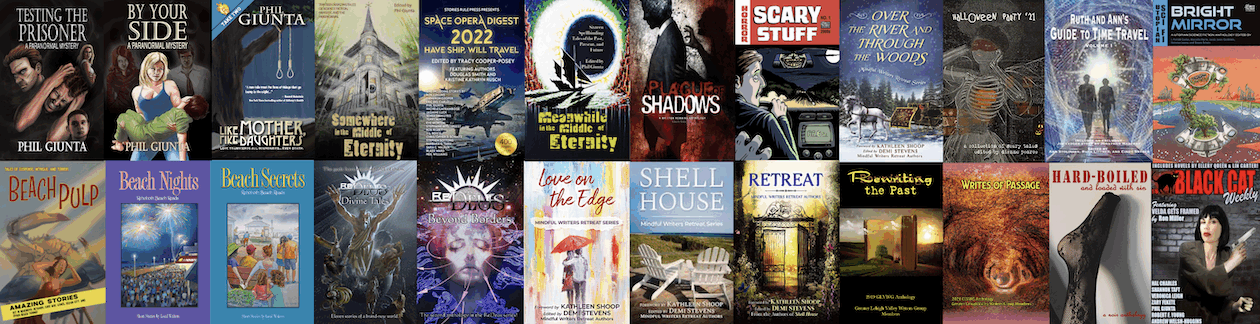
Over the River and Through the Woods Advance CopiesA beam of sunlight on an otherwise dreadful day. My two advance copies of the winter holiday anthology, Over the River and Through the Woods, featuring my story, “Limited Time Offer.” The book will debut on October 8! Whoo-hoo… or Ho-Ho-Ho… or something like that… 😄

The full roster of authors includes Lorraine Donohue Bonzelet, Jennifer Diamond, Abigail Drake, Phil Giunta, Kimberly Kurth Gray, N.J. Hammer, Hilary Hauck, Eileen Enwright Hodgetts, Lori M. Jones, Ramona DeFelice Long, Janet McClintock, MaryAlice Meli, Amy Morley, Sherren Elias Pensiero, Cara Reinard, James Robinson, Jr., Larry Schardt, Kathleen Shoop, Demi Stevens, Denise Weaver, and Michele Zirkle.  Edited by Demi Stevens.

All of the writers listed above are attendees of the Mindful Writers Retreat, which  occurs three times per year at the Ligonier Camp and Conference Center in Ligonier, PA. I had the pleasure of attending my first retreat in October 2018 and it will not be my last!

Proceeds from the sale of the anthology benefit the Ligonier Camp and Conference Center. Stay tuned for more info!

About This Writing Stuff…

This week, Ruth Harris lays solid groundwork when it comes to cliffhangers and David Safford reinforces the concept of the hero’s journey.

Mary Anna Evans helps us find our author voice while Nancy Bilyeau provides tips on crafting believable historical fiction. Struggling to avoid those ugly info dumps? Let Kris Kennedy show you how to adroitly divulge all those details you’re dying to share with the reader.

Although writers must develop a thick skin when it comes to receiving criticism, we’re often called upon to give it as well. PJ Parrish and Jim Dempsey discuss constructive methods for offering valuable and relevant critiques.

All that and a little more. Enjoy!

How to Write a Page-Turner: Master the Seven Rules of the Cliffhanger by Ruth Harris

The Hero’s Journey: How to Write the Crossing the Threshold Scene by David Safford

How to Find Your Author Voice by Mary Anna Evans

4 Tips for Writing Historical Fiction by Nancy Bilyeau

How Can We Make Scenes Feel Stronger with Sequels? by Jami Gold

Backstory: Avoid Info Dumping by Making it Essential Part One / Part Two / Part Three by Kris Kennedy via Jami Gold

The Fine Art of Giving Out Criticism by PJ Parrish

How to Give Useful Criticism by Jim Dempey

Seven Tips for a Satisfying Mystery by Oren Ashkenazi

Advice to Writers Who Are In It by Annie Neugebauer


Book Review: The Deadly Streets by Harlan Ellison

The Deadly Streets by Harlan EllisonFor ten weeks in the early 1950s, Harlan Ellison joined a notorious Brooklyn street gang known as the Barons as part of his research for his first novel, Web of the City and later, his crime collection, The Deadly Streets.

The first edition of The Deadly Streets was released in 1958 and contained 11 hard-boiled tales about teenage street gangs. The book was re-released in 1975 with an additional five crime stories, some written in collaboration with other writers including “Ship-Shape Pay-Off” with Robert Silverberg and “Sob Story” Henry Slesar.

What sets these additional five stories apart from the original 11 is that they are much shorter and completely unrelated to the theme of teenage street gangs. Rather, they tend to focus on mob hits (“The Man with the Golden Tongue”), revenge (“Rat Hater”, “Hippie Slayer”) and personal vendettas (the aforementioned “Ship-Shape Pay-Off”). “Sob Story” is the weakest of the lot and barely qualifies as a crime drama.

My personal favorites from the collection include “We Take Care of our Dead,” “The Man with the Golden Tongue,” “Johnny Slice’s Stoolie,” “Buy Me That Blade,” “Hippie Slayer,” “With a Knife in Her Hand,” “Dead Shot,” and “Students of the Assassin.”

Although the slang is outdated and the depictions of violence mild by today’s standards, each of the original 11 tales present a vivid snapshot of the bloody and ruthless street gang culture of 1950s New York.