Category Archives: Opinion

About This Writing Stuff…

February may be the shortest month of the year, but I managed to gather the largest collection of articles in quite some time on this blog. We begin with Margaret Atwood’s touching tribute to Ursula K. Le Guin.

Written Word Media offers ten publishing predictions in 2018 that are worth heeding and Writer Beware provides a comprehensive list of Author Solutions copycats.

Randy Ingermanson (aka “The Snowflake Guy”) gives us a lesson on Scene and Sequel. Lisa Cron encourages you to determine what your protagonist wants even before you start writing. Steven Pressfield reminds us that villains are not always people while Danielle Davis recommends (and I highly agree) that short stories provide an effective respite when you need a break from your novel.

All that and a lot more. Enjoy!

A Tribute to Ursula K. Le Guin by Margaret Atwood

Top Ten Publishing Trends Every Author Needs to Know in 2018 by Ricci

Writing the Perfect Scene by Randy Ingermanson

X-Ray for Authors: Tips and Tricks from Kindle Direct Publishing

The Strange Copyright of Doctor Who and The Shape of Non-Plagiarism by Jonathan Bailey

How To Write Memorable and Compelling Monologues by Ken Miyamoto

Army of Clones: Author Solutions Spawns a Legion of Copycats by Victoria Strauss for Writer Beware

Putting Conflict to Work in Your Stories, Part 1: Why Your Story Needs Conflict by Laura DiSilverio

Reboot Your Novel with the Short-Story Remedy by Danielle Davis

The Villain is Not Always a Person by Steven Pressfield

What Does Your Protagonist Want BEFORE the Story Starts? by Lisa Cron

Avoid Top 5 Writing Mistakes – Make Your Writing Better by AJ Humpage

About This Writing Stuff…

This week, we stop by the Kill Zone where James Scott Bell warns against starting your story with a dream while John Gilstrap and Jordan Dane talk internal monologue. Over at Mythcreants, Oren Ashkenazi advises against writing prequels, but if you must, he offers a few tips.

From Writer Unboxed, Julie Carrick Dalton provides timely advice on dual timeline stories. Think you can become a writer on “talent” alone? Anne R. Allen would like to give you a rude awakening. Anne also has some strong opinions on how to begin your story in order to optimize Amazon’s “Look Inside” feature.

All that and a little more. Enjoy!

What’s the Deal on Dreams in Fiction? by James Scott Bell

Internal Monologue by John Gilstrap

5 Key Ways to Balance Internal Monologue with Pitfalls to Avoid by Jordan Dane

Chronicling a Non-Chronological Story: Writing a Dual Timeline Novel by Julie Carrick Dalton

Five Tips for Telling Prequel Stories by Oren Ashkenazi

8 Qualities that are More Important than Talent for Writing Success and The One Thing That Will Kill Book Sales Dead and 10 Ways to Avoid It by Anne R. Allen

How to Write a Novel Using the Snowflake Method by Randy Ingermanson

How to Spark Your Story with an Inciting Incident by Pamela Hodges

Veteran SF and Media Tie-In Writer, Michael Jan Friedman, Would Like to Take You Into Empty Space

About This Writing Stuff…

This week, Goodreads announces a change to its US giveaway program and it comes with alarming costs. The Authors Guild provides information on the new GOP tax bill and Douglas Preston laments the fact that writers can no longer make a living from their craft.

From The Guardian, a recent study comparing literary fiction against science fiction returned rather “stupefying” results. John Gilstrap discusses the importance of book cover design while K.M. Weiland and Becca Puglisi each offer different tactics for character development.  From Writers Helping Writers, Sacha Black gives us the nitty gritty on sentence structure.

All that and a little more. Enjoy!

Goodreads Announces New US Giveaway Program by Greg Seguin

What Authors Need to Know About the New Tax Bills by The Authors Guild

Why Is It So Goddamned Hard to Make a Living as a Writer Today? by Douglas Preston

(Too) Close Third Person by Jeanne Kisacky

Science Fiction Triggers ‘Poorer Reading’, Study Finds by Alison Flood

Judging a Book By Its Cover by John Gilstrap

4 Ways to Amplify Your Characters’ Subtext by K.M. Weiland

Writing Characters that Mirror Real Life by Becca Puglisi via Kristen Lamb

Action Beats: More than Dialogue Tag Surrogates by Kathy Steinmann

Getting Jiggy with the Nitty Gritty, or, Improving Your Sentences by Sacha Black

About This Writing Stuff…

This week, David Gaughran and Anne R. Allen analyze Amazon’s heavy-handed measures of fraud detection that are forcing the innocent to suffer for the guilty. P.J. Parrish illustrates the revision process using one of her own manuscripts while Ruth Harris and Andrew Falconer offer tips on writing historical fiction.

We strike gold with… who else, but… Jami Gold! Jami is busy with NaNoWriMo, so she has invited guest bloggers to discuss such topics as Imposter Syndrome (Kassandra Lamb), Deep POV (Lisa Hall-Wilson), and Productivity (J. Rose).

From the latter, this statement leapt out at me: “We’re trained to work ourselves to the bone, and that we should best each other about “who’s the most busy” or “who has the least amount of time.” I challenge you to step away from this game! Do you really want to be #1 at being stressed and being busy all the time so you don’t have time to enjoy your life?”

All that and a little more. Enjoy!

Amazon’s Hall of Spinning Knives by David Gaughran

Don’t Let Impostor Syndrome Ruin Your Writing by Kassandra Lamb via Jami Gold

Deep POV and Hidden Messages in Subtext by Lisa Hall-Wilson via Jami Gold

Creating the Right Mindset to Be Productive by J. Rose via Jami Gold

Cutting Open the Sausage: A Hard Look at Rewriting by PJ Parrish

Plunge Into Story Action—and Genre by Kathryn Craft

A Character’s POV = A Character’s Truth by Sarah Callender

Five Essentials of Historical Fantasy by Andrew Falconer

How to Use Authentic Historical Detail to Trigger Emotions and Memories in Your Readers by Ruth Harris

The Most Important Rule of Backstory by Andrea Lundgren

Amazon’s Latest Crackdowns: Do They Include Amazon Review Trolls? by Anne R. Allen


On Providing Useful Critiques…

As Neil Gaiman said: “When people tell you there’s something wrong with a story, they’re almost always right. When they tell what it is that’s wrong and how it can be fixed, they’re almost always wrong.”

Just a gentle reminder for all of us who critique stories. Remember to always begin with the positives before delving into the criticism, and refrain from dictating to the writer how you think they should write their story and how you think their characters should behave.

If that’s the story you want to read, write it yourself. Don’t tell the writer what to do. It’s the writer’s story and the ultimate decisions are up to the writer. Respectfully inform them of what problems you found in the story and offer suggestions. Leave it to the writer to do the work.

I’m reminded of an anecdote shared by actor Lance Henriksen in his autobiography, Not Bad for a Human. While working on Close Encounters of the Third Kind, Henriksen offered an idea to Spielberg that the government team at Devil’s Tower should kidnap one of the small aliens at the end of the film. Spielberg replied: “That’s a different movie, Lance.”

Click here for excellent guidelines on critiquing from The Writer’s Loft. 


Getting Back on Track

So I recently finished a short story about a young man who buys a haunted Camaro—and inadvertently destroys the life of a paroled car thief. The story is now in the hands of critique partners and happens to be the only writing project that I actually finished this year. If you followed any of my previous updates, you’ll know that 2017 has kicked the shit out of me and in doing so, caused my writing output to plummet. 
 ‌
Going into 2017, I promised myself not to write any more short stories this year so I could focus on the first draft of the SF novel I started writing last year. Four chapters into the first draft by April 2016 and the novel ended up on the back burner for a home renovation, a Kickstarter to fund a new anthology, the release of said anthology, and writing six new short stories for contests and anthologies.
 ‌
As productive as that was and as proud as I am of those stories, the SF novel languished. Then came 2017 and I set my sights on finishing the first draft by December. Four more chapters were written between January and May… and the novel was again sidelined while I edited submissions to a new anthology, finished a month-long home renovation, then watched my summer collapse along with the roof at my workplace as a result of a severe storm. I want my summer back, damn it!
 ‌
So, to get my writing chops back in shape, I cranked out the aforementioned short story about the haunted car—just so I could feel good about finishing something this year.  I thought I would then return to the SF novel…
 ‌
Instead, I’ve spent the past week crafting the plot synopsis for my next full-length Miranda Lorensen novel. Almost there. I spent more time working on it in my sunroom this evening—and peeking up every so often to watch a tiny bunny roam around my neighbor’s shed. Who can resist bunnies?
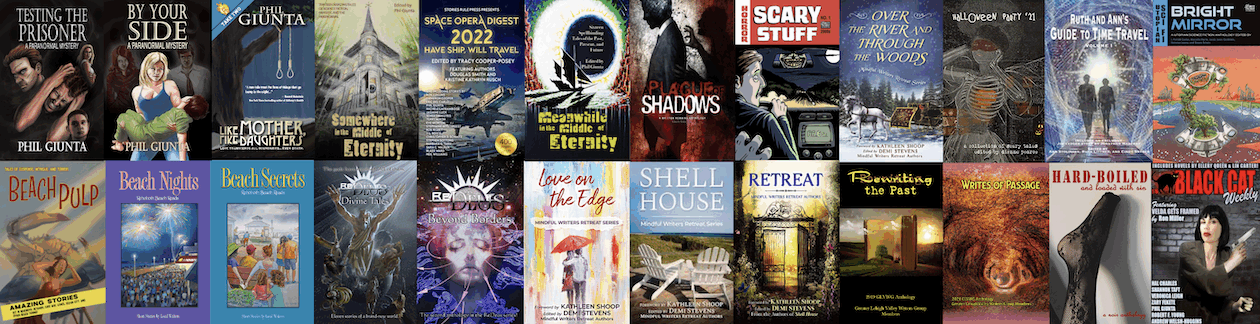
If all goes as planned, this novel will tie directly to the novella that my publisher accepted back in June. The novella, Like Mother, Like Daughters, addresses some aspects of Miranda’s life mentioned in my novels Testing the Prisoner and By Your Side
 
I jotted down a quick jacket blurb for the novella recently. It needs work, but…
 
Psychic-medium Miranda Lorensen and her daughter Andrea set out for a “girls night of ghost hunting” at the home of Andrea’s closest friend, Wendy. When Andrea Lorensen stumbles over Wendy’s dead body in the woods, the shock triggers Andrea’s own latent abilities as a medium. Against her mother’s wishes, Andrea decides to ensnare Wendy’s killer with help from the other side.
Meanwhile, Miranda travels to Salem, Massachusetts to speak at a paranormal investigators conference. When she is invited to participate in a local ghost hunt, Miranda encounters a spirit that leads her to the truth about her past life.
Like Mother Like Daughters title
Now, hopefully, the novella will be released next year with the novel to follow a year or so later. My concern is that as of 2018, it will have been FIVE years since my last novel. Yikes!  
 
During that time, I’ve been focused on short stories and editing anthologies, which has proved fruitful. My publisher and I have released two volumes of the Middle of Eternity speculative fiction series, my work has placed high in a few local contests, and I’ve been published in a handful of other wonderful collections such as the ReDeus mythology series and Beach Nights. I firmly believe that short stories and novellas are nutritious parts of a well-balanced writing career. 
 ‌
As much fun as those projects have been, a few solo publications are definitely needed within the next year. While Miranda has earned a modest fan following–and several readers have contacted me to ask when to expect her next adventure–people have short memories these days so I hope all of this works out as planned!