 One of Jack Vance’s most influential works and the first in a series, The Dying Earth is comprised of six fantasy adventures that are tangentially connected. They take place in Earth’s far future, during a time when the sun is approaching the end of its life and has become, it seems, a red dwarf. The human population has diminished significantly and most of the planet’s history long forgotten.
Each story involves magic and sorcery with a loose foundation in science. Some level of technology still exists, but it is not always well understood by the characters.
The six thoroughly enjoyable tales include:
“Turjan of Miir” – Although skilled in creating humanoid life, a magician seeks the necessary spells to imbue it with intelligence. To do so, he must travel to another realm and seek the legendary sorcerer known as Pandelume.
“Mazirian the Magician” – The diabolical Mazirian captures Turjan and tortures him into revealing the necessary spells to imbue his creations with intelligence. However, Mazirian is distracted by the appearance of a beautiful young maiden who visits his property each day on horseback but flees whenever he confronts her. Eventually, Mazirian decides to set off in pursuit.
“T’sais” – An artificial woman created by the wizard Pandelume, T’sais once despised all living beings, including herself. This personality flaw made her combative, unreasonable, and violent. After speaking with her “twin sister” T’sain—created by Turjin to be gentle and kind—T’sais is persuaded to end her treacherous ways. She journeys to Earth to find love and encounters a benevolent man named Etarr who once made the mistake of falling in love with an evil witch. The witch exchanged his face for that of a demon, forcing Etarr to wear a mask. Together with T’sais, Etarr sets out to confront the witch and reverse the spell.
“Liane the Wayfarer” – In order to win the heart of a beautiful but reclusive young witch, an arrogant, callow adventurer undertakes a quest to retrieve the other half of a tapestry that hangs in the witch’s home. To do this, he must steal it from the castle of the dreaded creature known as Chun the Unavoidable.
“Ulan Dhor Ends a Dream” – An apprentice wizard arrives in the city of Ampridatvir on a quest to recover a pair of ancient tablets that, according to myth, provide access to ancient and powerful magic. Ulan is immediately mistaken for a raider due the color of his clothing and soon learns that color has meaning in this strange land. He meets the lovely Elai, who instructs him on the ways of her people and accompanies him on his quest. After a series of mishaps, the pair awaken the high priest of the region who is perturbed by the population’s lack of intellectual progress and decides to do something about it.
“Guyal of Sfere” – Rather than continuing to vex his father and the other elders of Sfere with his unquenchable thirst for knowledge, young Guyal sets out in search of the legendary Museum of Man and its omniscient curator. During his journey, Guyal encounters several dangers, including a hovering ghost on his way into the village of Saponce, where he inadvertently breaks a law and is sentenced to a strange punishment—he must choose the fairest maiden in the village during a pageant. He chooses Shierl, the daughter of a high-ranking Saponce official. In doing so, Guyal unwittingly dooms Shierl as a sacrifice to the demon that resides in the Museum of Man.
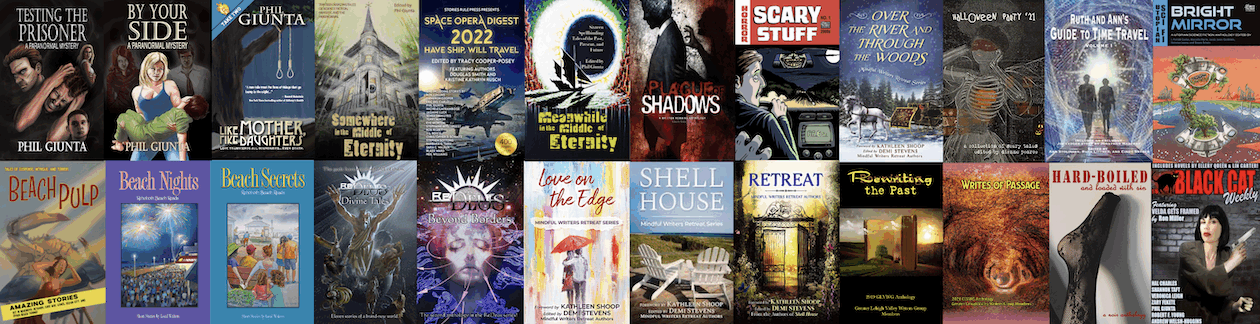
 In all of the chaos of the election and our Indiegogo campaign to fund the publication of Meanwhile in the Middle of Eternity, I neglected to mention that not only has the Scary Stuff anthology been released, but my author copy arrived on Halloween!
 Defintely a treat! Even my ghoulfriend found it a jaw-dropping read and she ain’t easy to please.


 Scary Stuff, published by Oddity Prodigy Productions, is an homage to the classic EC Comics titles Tales from the Crypt, Vault of Horror, and Haunt of Fear as well as the magazines Creepy and Eerie. The anthology includes my story. “Burn After Writing,” dedicated to one of my litrary heroes, Harlan Ellison (below).

 I read this collection of 27 speculative fiction tales immediately after

 This marvelous collection of 24 stories includes such gems as “Fair Game,” “The Hanging Stranger,” “The Last of the Masters,” “War Veteran,” “Exhibit Piece,” “Sales Pitch,” “The Chromium Fence,” and several tales that were adopted into film, such as “We Can Remember it for You Wholesale” (Total Recall, 1990), “The Minority Report” (Minority Report, 2002), “The Golden Man” (Next, 2007), and “Second Variety” (Screamers, 1995).